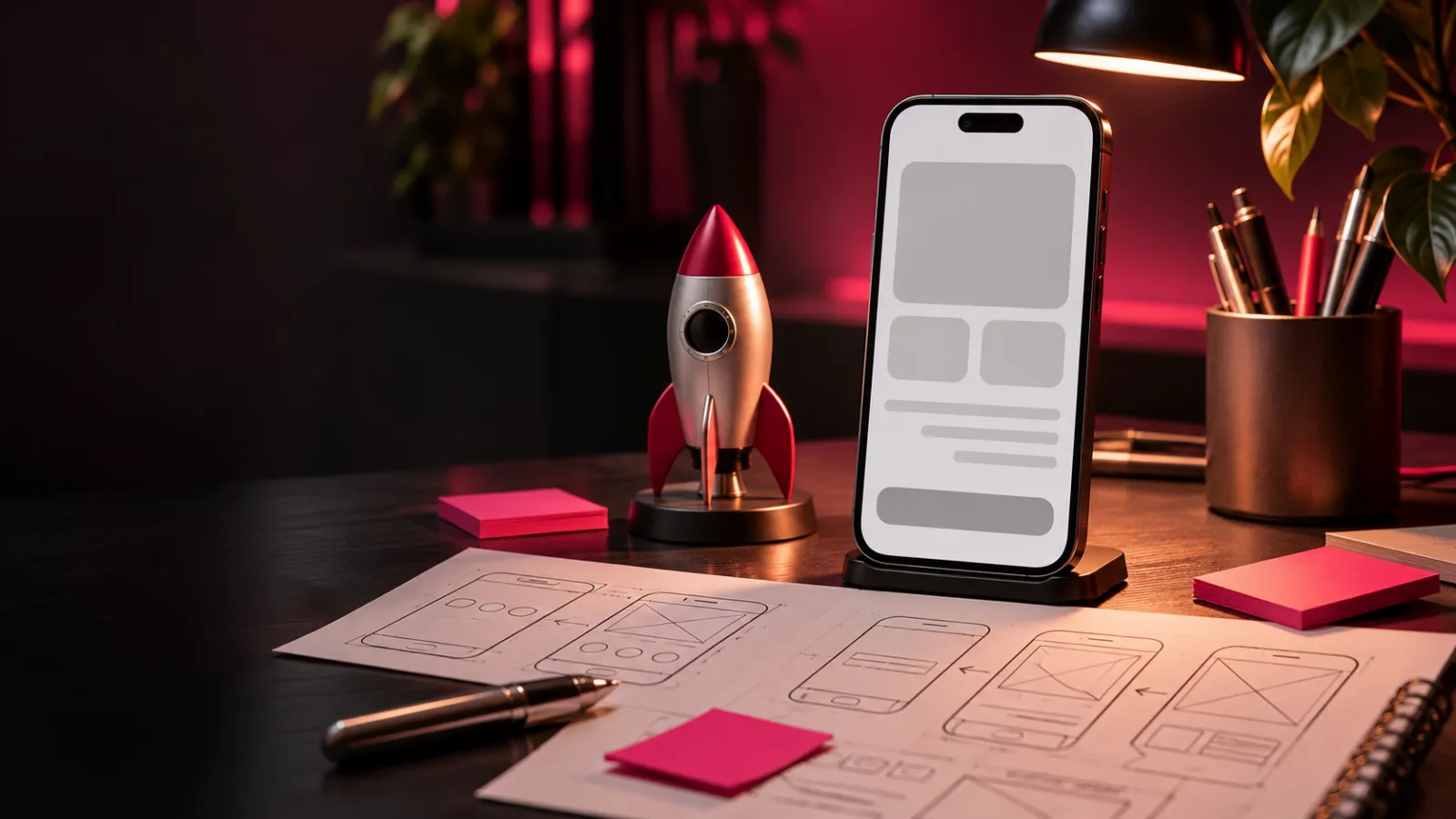
- An MVP is the smallest version that solves a real user’s core problem and lets you learn.
- “Minimum” doesn’t mean poor; the chosen features must be well designed and well built.
- Sort features into essential, important and later — and build only the essential.
- Decide before launch what you will measure and what success means.
- Use manual solutions behind the scenes at first instead of automating everything.
An entrepreneur has an idea for an app to book home maintenance services. The feature list in their head is long: a customer app and a technicians’ app, live map tracking, an e-wallet, loyalty points, monthly subscriptions, chat, ratings, an admin panel with advanced reports, and support for five cities. They build it all over a full year, then launch — only to discover that customers actually want something simpler: a trustworthy technician who arrives on time at a clear price. And half the features are used by no one.
This story repeats often, and its solution is a simple concept called the first version, or “minimum viable product” (MVP). In this article we explain how we apply it in our mobile app service to protect the client’s budget and speed up their time to market.
What is an MVP, really?
An MVP is the smallest version of a product that solves the core problem of real users well and lets you learn from their actual usage. Three words matter in this definition:
- Smallest: no feature except what the user needs to complete the core task.
- Well: the few chosen features must work flawlessly and be designed respectably. An MVP doesn’t mean a broken or ugly app.
- Learn: the goal isn’t just to launch but to gather data that decides what gets built next.
A common analogy: if the goal is to get someone from A to B, the MVP isn’t a car wheel, then a chassis, then an engine; it’s a working bicycle, then a motorbike, then a car. At every stage the user gets real transport, and you learn what they actually need.
How do you choose the first version’s features?
Step 1: Define the core task
Write one sentence: “The user [who?] wants to [what?] so that [why?].” For example: “A homeowner wants to book a trustworthy air-conditioning technician at a specific time so they can fix the fault without wasting their day on phone calls.” Every feature in the MVP must serve this sentence directly.
Step 2: Map the journey from start to finish
What’s the minimum number of steps? Open the app, choose the service, set the location and time, confirm the order, receive a notification that the technician is confirmed, the work is done, pay, rate. These are the core screens.
Step 3: Classify every feature
| Category | Criterion | Example (maintenance app) |
|---|---|---|
| Essential | Without it the core task can’t be completed | Choosing the service, time, location, confirmation, a simple admin panel for orders |
| Important | Improves the experience a lot, but you can launch without it | Online payment, ratings, advanced notifications |
| Later | Nice, but the need isn’t proven | Wallet, points, subscriptions, live tracking, chat |
Build the “essential”, add from “important” what time and budget allow, and postpone the rest.
The power of manual solutions
One of the smartest MVP techniques is to offer a service that looks automated to the user while part of it is done manually behind the scenes. Instead of building an algorithm to assign orders to technicians, a staff member receives orders in the admin panel and assigns them personally. Instead of a complex payment gateway at the start, payment can happen when the service is completed. These solutions let you launch quickly and understand the process well before automating it, then build the automation once volume justifies it.
What can’t be cut in an MVP?
- Security and data protection: there is no “first version” of security. Read app security.
- The quality of the core experience: the main journey must be smooth.
- The visual identity: first impressions matter, and professional design doesn’t cost much when there are few screens.
- Measurement: analytics and crash reporting from day one.
- An architecture that can grow: no need to build everything, but design the foundation so you don’t have to rewrite it when you scale.
Define success criteria before launch
Before launching, write down what you’ll measure and what number means “the idea works”. Examples:
| Indicator | The question it answers |
|---|---|
| Core task completion rate | Can users complete a booking? Where do they stop? |
| Repeat usage | Does the user come back after a week or a month? |
| User acquisition cost | How much does it cost to reach a user who completes the task? |
| User satisfaction | Ratings, interviews and direct feedback |
| Revenue or savings | Do people pay? Does the app save the team time? |
Without these criteria it’s easy to read any result as success or failure depending on your mood.
After launch: learn, decide, repeat
- Gather data: usage analytics, crash reports, ratings.
- Talk to users: short interviews with those who used it and those who stopped.
- Decide: continue in the same direction with improvements, adjust part of the idea, or change the audience or the model?
- Build the next release: from the “important” and “later” lists, but in a new order set by the data.
Short cycles of 4 to 8 weeks between releases keep the product continuously improving. Read app maintenance and updates.
Common misunderstandings of the MVP
- Treating it as a poor version: so an app full of crashes comes out and damages the brand.
- Inflating it: “we’ll just add this one feature” until it becomes the full app.
- Launching without measurement: so you don’t know what you learned.
- Launching without users: an app no one knows about tests nothing. Plan how to reach your first hundred users. Read app marketing.
- Ignoring what users say: and sticking to the original plan despite the data.
Example: from the first version to the third
Back to the home maintenance app. The first version launches in one city with only three services (air conditioning, plumbing, electrical), a customer app and an admin panel from which one staff member assigns orders to ten contracted technicians, with payment when the service is finished. After two months the data shows that most orders are for air conditioning, and that customers call a lot to ask “when will the technician arrive?”. The decision for version two becomes clear: a simple technicians’ app where they update their status, customer notifications when the technician is on the way, and online payment. Four months later, repeat air-conditioning customers ask for a scheduled visit before summer, so version three brings recurring maintenance subscriptions and expansion to a second city.
Notice that every feature was added on the evidence of real usage, and that features such as the wallet, points and chat were never built because nobody needed them. That’s the difference between a product that evolves with its customers and one built on its founder’s guesses. (The example is illustrative, to explain the idea.)
The rule we repeat to our clients: every feature must “earn its place” in the app with evidence from users, not with enthusiasm in a meeting. What doesn’t earn its place today may earn it tomorrow when users’ needs change, so don’t delete ideas — keep them on an ordered list.
Cheaper alternatives for testing before an app
Sometimes you can test the idea before building any app: a landing page explaining the service and collecting sign-ups, an interactive prototype shown to potential customers, or delivering the service manually through WhatsApp and a web form for a limited number of customers. If nobody is interested in the page or the manual service, an app won’t change that. Read app, website or PWA and landing pages.
The bottom line
A smart first version solves the core problem flawlessly, launches quickly, measures and learns. Don’t build everything at once; build what proves the idea, then let users guide the next releases. We help you define the first version’s scope and build it in our mobile app service. Read app cost, or get in touch.
Real projects we delivered
FAQ
Is an MVP for established companies or only startups?
Both. An established company launching a new app benefits just as much from testing real usage before investing in every feature.
How many features should the first version have?
There’s no fixed number. The rule: everything the user needs to complete the core task well from start to finish, and nothing more.
What if the MVP doesn’t succeed?
That’s a useful result at far lower cost than building the full app. Analyse why: is the problem the idea, the audience, the marketing or the experience? Then adjust or change direction.

Written from 20+ years designing websites and identities for clients in Saudi Arabia and Egypt — every tip here comes from real projects.
Want this applied to your project?
Book a free consultation — we will review your site or brand and propose a clear plan.
Book a free consultation