
- WordPress is the best choice for most company websites, blogs and mid-sized stores.
- Custom development is justified when the site is a “system” with its own business logic, not just pages.
- Closed platforms are easy to start with but limit your ownership and customisation.
- WordPress security depends on updates, hosting and the number of plugins — not on the platform itself.
- You can combine them: a WordPress marketing site plus a separate custom system for operations.
One of the questions we hear most in a first meeting is: “Will you build the site with WordPress or with custom code?”. Some clients have heard that WordPress is “not professional”; others have heard that custom code is “stronger”. The truth is that each option is a tool for a particular situation, and the wrong choice costs money, time and years of headaches.
What is WordPress?
WordPress is an open-source content management system that powers a huge share of the web, from small blogs to media and government websites. Its strength lies in easy content management, thousands of plugins and a vast developer community — which means you will never be held hostage by a single company.
What is custom development?
Building the site from scratch in a language and framework (Laravel, Next.js, .NET…) exactly to your requirements. It gives full control, but it takes longer and costs more, and every later change needs a developer who knows the code.
A direct comparison
| Criterion | WordPress | Custom development | Hosted builders (Wix and similar) |
|---|---|---|---|
| Initial cost | Low–medium | High | Low |
| Speed to launch | Fast | Slow | Very fast |
| Ease of content management | Excellent | Depends on what’s built | Good |
| Design flexibility | High | Unlimited | Limited |
| SEO | Excellent | Excellent if built correctly | Average |
| Ownership and portability | Full | Full (if you receive the code) | Tied to the platform |
| Maintenance | Regular updates | A specialist developer | On the platform |
| Complex business logic | Limited | Excellent | Not suitable |
When do we recommend WordPress?
- A company brochure or corporate site with service pages, projects and a blog.
- A bilingual site that your team needs to update continuously.
- A small or mid-sized online store with WooCommerce.
- When you want any other developer to be able to take over in the future.
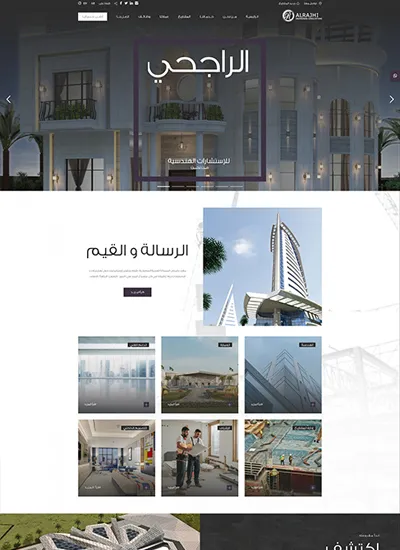
This very website is built on WordPress with Elementor, Polylang and a custom theme — and so is the site of Al Rajhi Engineering Consultants and most of our clients’ sites.
When do we recommend custom development?
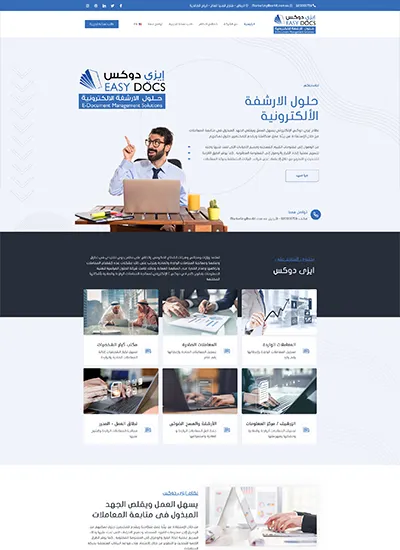
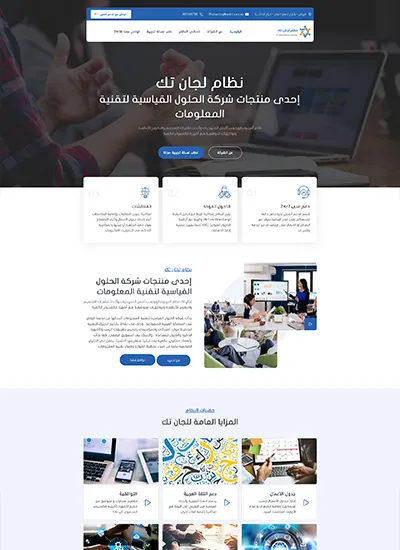
- Systems with their own business logic: committee management, document archiving, client portals — like Lijan Tech and EasyDocs, where the marketing site is one thing and the system is another.
- Platforms with very large user numbers and special performance needs.
- Deep integrations with ERP or government systems.
The hybrid approach: often the best option
A marketing site on WordPress (fast, easy to update, strong for SEO) plus a custom application or system on a subdomain such as app.example.com. This way the marketing team gets its flexibility and the system gets its power.
WordPress myths
- “WordPress is only for blogs”: it runs large corporate sites and stores with thousands of products.
- “WordPress is slow”: slowness comes from heavy themes, too many plugins and weak hosting. A carefully built site is very fast. See our speed guide.
- “WordPress is insecure”: security is a practice, not a platform. Read our WordPress security guide.
Questions that settle the decision
- Is the site pages and content, or a system with processes and users?
- Who will update the content, and how often?
- What is your budget for the build and for yearly maintenance?
- Do you need to launch within weeks, or can you wait months?
- Do you want the freedom to change agency later?
Practical examples of the decision
A contracting company wants a brochure site with a project database, a blog and service pages, and its team wants to add projects itself. Here WordPress with a custom theme designed for its identity is an excellent choice: a familiar dashboard, flexible content, a reasonable cost and a strong SEO ecosystem. Our own site is built the same way — a fully custom WordPress theme with content managed in Arabic and English.
A booking platform that connects hundreds of service providers with thousands of customers, with dynamic pricing, e-wallets and mobile apps. Here custom development on a modern framework fits better, because complex logic, performance under load and app integration need an architecture designed for exactly that — although WordPress could still be used later for the blog and marketing pages.
A mid-sized online store in Saudi Arabia: the choice is between hosted platforms such as Salla and Zid, or WooCommerce on WordPress, depending on the need for customisation and integrations. Read Salla and Zid or WooCommerce.
WordPress done right: the difference between an excellent site and an annoying one
Most negative impressions of WordPress come from how it was built, not from the platform: a heavy off-the-shelf theme loaded with dozens of unused features, forty overlapping plugins, pirated plugins and neglected updates. The right way is completely different:
- A lightweight custom theme built only for your identity and features, not a multipurpose theme.
- A few trusted, up-to-date plugins, with everything unused removed.
- Tuned performance: caching, modern image formats and suitable hosting. Read website speed.
- Protection: regular updates, two-factor authentication and backups. Read WordPress security.
- A simplified dashboard that shows your team only what it needs to update content without breaking the design.
Built this way, a site combines the ease and flexibility of WordPress with the quality and performance of a custom-coded site.
Long-term cost
When comparing, don’t look only at the build cost — look at the first three years. WordPress has a very wide pool of developers, so if you ever need to change agency you will find many alternatives. A custom-coded site may be faster and more precise for its functions, but its development and maintenance depend on a team that understands its specific code, and every change needs a developer rather than a content editor. Ask yourself: who will add articles and projects? How often will you need changes? What does each change cost in each case? The answer shows which option is really cheaper.
What about hosted website builders?
Besides WordPress and custom development, there are drag-and-drop builders with a monthly subscription. They suit a simple page for a personal project or quickly testing an idea, but they are often limited in controlling Arabic RTL design, advanced SEO, structured data, performance and moving the site elsewhere later. A company building a digital presence for years usually needs full ownership of its site and content and the ability to develop it without platform restrictions. That’s why we recommend them only for temporary cases, not as the foundation of a company website.
Questions to ask the agency before deciding
- If we choose WordPress, is the theme custom-built or a modified ready-made theme? How many plugins will the site use?
- If we choose custom development, which framework? Is it easy to find developers for it? Who owns the code?
- How will our team add content? Can we see the dashboard before starting?
- How will security updates be handled, and who is responsible after handover?
- What is the expansion plan if we need a store or an app later?
Clear answers to these questions reveal an agency’s expertise better than any presentation. Read how to choose a web design company.
Security: is WordPress less secure?
Because WordPress powers so much of the web, it is a favourite target for automated attacks, which leads some people to think it is less secure. In reality, most hacks come from outdated plugins or themes, unofficial sources or weak passwords — not from WordPress core, which receives regular security updates. Conversely, a custom-coded site is not automatically secure: its security depends entirely on the quality of the team that wrote, reviewed and tested it, and it does not benefit from a huge community that finds and fixes vulnerabilities. In both cases security is the result of practices: updates, correct permissions, a firewall, backups and monitoring. Read recovering from a hack.
A decision that doesn’t have to be final
Choosing WordPress today doesn’t stop you building a custom system tomorrow for a specific function, and vice versa. Many successful sites start with WordPress for content and marketing, then add specialised systems alongside it that connect when needed. What matters is that the foundation is clean, documented and in your name.
The bottom line
For most companies, a carefully built WordPress site is the smartest choice. For complex systems, custom development — ideally separate from your marketing site. If you are unsure, book a consultation and we will honestly recommend what fits, or explore our website design service.
Real projects we delivered
FAQ
Is WordPress secure for company websites?
Yes, if it is updated regularly and uses a few trusted plugins, good hosting and backups. Most hacks come from outdated plugins or weak passwords.
Is WordPress good for SEO?
Excellent. It generates clean URLs, supports sitemaps and structured data, and makes it easy to publish content regularly — the most important factor.
When do I need custom development?
When there is complex business logic: a client portal with permissions, bookings with special rules, deep integrations with internal systems, or a platform with very large numbers of users.
Sources

Written from 20+ years designing websites and identities for clients in Saudi Arabia and Egypt — every tip here comes from real projects.
Want this applied to your project?
Book a free consultation — we will review your site or brand and propose a clear plan.
Book a free consultation