
- A contracting client looks for proof: completed projects with real photos, classification, certificates and clients.
- A page per project with location, area and duration beats a generic photo gallery.
- A downloadable company profile is essential for tenders and government bodies.
- Local SEO (city + type of contracting) brings direct enquiries.
- A WhatsApp button and a clear number: most enquiries start on mobile.
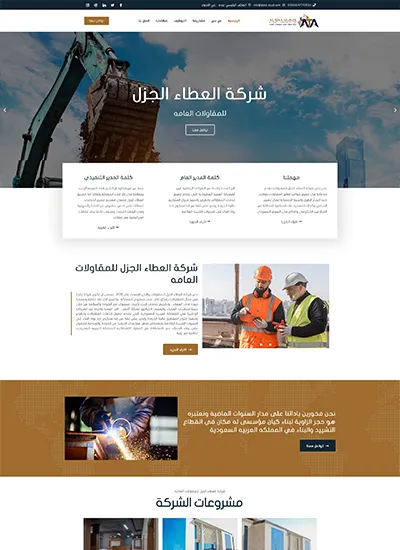
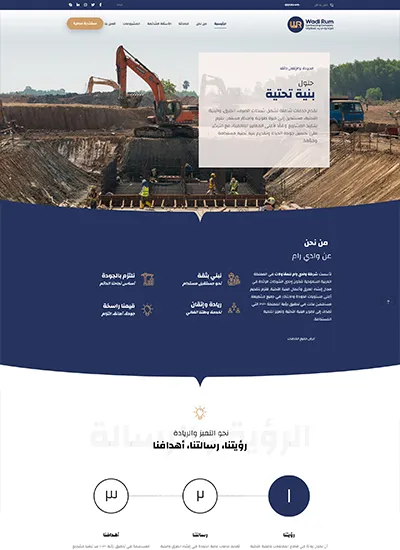
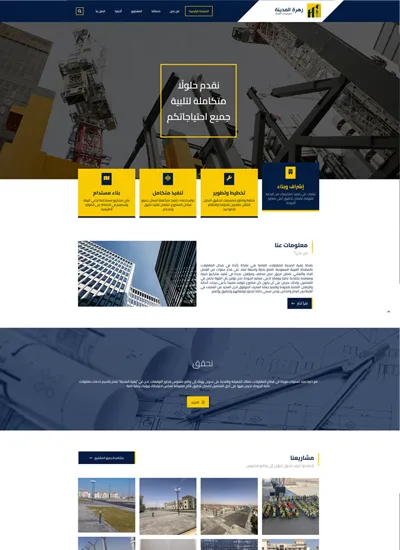
In Saudi Arabia especially, contracting is one of the most competitive sectors online. The villa owner searching for “building contractor in Riyadh”, the procurement manager reviewing contractors for a commercial project, and the tender committee that visits your website before awarding — all of them judge your company by its website. We have designed sites for companies such as Raghad Projects, Mawarid Al Itqan and Zahrat Al Madina, and this is what we have learned.
Who visits a contracting company’s website?
| Visitor | What they look for | What convinces them |
|---|---|---|
| Private project owner (villa, building) | A trustworthy contractor nearby | Photos of similar projects, reviews, easy contact |
| Company procurement manager | Delivery capacity and experience at the required scale | Projects of specific sizes and types, team and equipment |
| Government tender committee | Classification, registration, certificates, track record | Official data and a downloadable profile |
| Main contractor looking for a subcontractor | A specific specialisation | A clear page for each specialisation |
The pages a contracting website needs
1. A home page that proves scale from the first screen
An image of a real, large project, a clear headline (“General contracting and finishing in Riyadh since 2013”), and figures: number of projects, years of experience, classification. Then buttons: “Request a quote” and “See our projects”.
2. A page for each specialisation
General contracting, renovation, finishing, insulation, MEP works… each specialisation gets a page targeting its keywords together with the cities you work in.
3. Completed projects — the heart of the site
A page for every project, containing:
- Project type, city and district.
- Area, construction period and scope of works.
- Photos before, during and after construction.
- The owner or consultant (if permitted).
- The challenge and how it was solved.
These pages appear in search under project and district names, and they convince more than any marketing copy.
4. About us + team + equipment
Experience, engineers, quality and safety certificates, and the equipment fleet with photos.
5. Accreditations and classification
Classification, commercial registration, chamber memberships, ISO certificates and civil defence certificates — on a separate, printable page.
6. A downloadable profile
An up-to-date PDF the procurement manager can send to the committee. Read our company profile design guide.
7. Request a quote
A short form: project type, city, approximate area, mobile number, and the option to attach drawings.
Local SEO for contracting companies
- Target “type of contracting + city” combinations: “renovation contractor in Jeddah”, “roof insulation company in Riyadh”.
- Activate your Google Business Profile with project photos and ask clients for reviews. Read our local SEO guide.
- Add structured data for the business type, address and service areas.
- Publish articles that answer owners’ questions: villa construction cost, building stages, the difference between insulation types.
Common mistakes on contractor websites
- Stock photos of buildings in other countries — clients spot them immediately.
- A photo gallery with no data about the projects.
- A 50 MB PDF profile that won’t open on a phone.
- No mobile number or WhatsApp button, or hiding them on the contact page only.
- A single-language site despite dealing with foreign companies.
The contracting company’s visual identity
The website is part of a bigger picture that includes vehicles, helmets and site hoardings. Read visual identity for contracting companies.
The ideal project page for a contractor
The project page is the most important page on a contracting website, because it is the practical proof of experience. A strong page contains: the project name and type, the owner (with permission), the location, the year of completion or handover, the company’s exact scope (structure, finishing, MEP, turnkey), the area or size if possible, an organised gallery from construction to handover, and a paragraph on the main challenge and how it was handled. Add links to similar projects and a button to request a quote for a similar project.
Make the project list filterable by sector (residential, commercial, government, industrial), city and status (completed, under construction). A project manager or consultant looking for “similar experience” should find it within seconds. Read digital identity and tenders.
Photos and video: invest in documentation
Project photos are the strongest content a contractor has, yet many companies don’t document their projects well. Assign someone to photograph each project at its different stages from a fixed point, hire a professional photographer at handover, and use drone footage where regulations allow. Short videos of construction stages work for both the website and social media. Read social media for contracting companies.
Trust and accreditations
Owners, developers and government bodies look for signs of stability: year of founding, classification if any, quality and safety certificates, the number of engineers and technicians, owned equipment and past clients. Show these indicators clearly on the home and about pages, with real photos of the team and equipment. Avoid inflated figures, because they are compared with official documents during qualification.
Website, profile and qualification file: one system
A contracting company works with three linked digital documents: the website everyone sees, the company profile sent to clients, and the qualification file prepared for tenders. When the three are designed with one identity and consistent content, clients see the same company wherever they meet it, and your team saves a lot of time because projects, photos and figures are kept up to date in one place. Read company profile design and branding for contracting companies.
Mobile speed on the construction site
Many visitors to contractor websites browse on their phones on site or on the move, sometimes on a weak connection. At the same time, contractor sites are full of large images. The solution is not fewer images but properly prepared ones: modern formats such as WebP, multiple sizes for each screen, lazy loading for images further down the page, and galleries that don’t load every image at once. That way the site stays visually rich and fast at the same time. Read website speed.
A bilingual contracting website
If the company works with foreign consultants or international developers, or bids for tenders requiring English documents, the English version is a necessity. Make it polished rather than machine-translated, with correct engineering terminology, and linked page by page to the Arabic version. Read our bilingual website guide.
From visit to quote request
The ultimate goal of a contracting website is to turn an interested visitor into a quote request or a meeting. Make it easy with a short request form asking for project type, city, approximate area and expected start date, with an option to upload drawings, plus a visible WhatsApp button and a tappable phone number. After submission, a thank-you page explains what happens next and when someone will be in touch. Most important of all: a genuinely fast reply from the sales team, because a client requesting quotes from several companies leans towards whoever replies first, professionally.
Measure these requests: how many come from the website each month? From which pages? How many become contracts? These numbers tell you the website’s real value and guide its next improvements. Read conversion rate optimisation.
The content project owners look for
Add articles that answer owners’ questions before they sign: how to choose a contractor, the stages of building a villa, the difference between a turnkey contract and a labour-and-materials contract. These articles attract clients early in their journey and present your company as a trusted expert before the client starts comparing prices.
The bottom line
A successful contracting website is a living “track record”: real projects with data, clear accreditations and fast ways to get in touch. If you want a website that works as a sales representative for your company, explore our website design service or book a consultation.
Real projects we delivered
FAQ
What is the most important page on a contracting company website?
The completed projects page — provided every project has its own page with real photos and data (type, location, area, owner if possible, duration).
Should I put my classification and commercial registration on the site?
Yes. Your contractor classification, commercial registration and quality certificates are strong trust signals for clients and tender committees.
What if I don’t have good project photos?
You can photograph current projects, or create professional visual scenes based on your real work — while avoiding stock photos that destroy trust.
Sources

Written from 20+ years designing websites and identities for clients in Saudi Arabia and Egypt — every tip here comes from real projects.
Want this applied to your project?
Book a free consultation — we will review your site or brand and propose a clear plan.
Book a free consultation