
- Real projects are the strongest content; document them from day one.
- Write in precise engineering language that non-specialists can understand.
- LinkedIn and Instagram are the core, and short video shows progress convincingly.
- Respect safety, confidentiality and owners’ consent in every photo.
- A design per platform within one identity turns the account into a living portfolio.
Few sectors have the visual material that engineering and contracting have: an empty plot that becomes a building within months; steel, concrete, cranes and work crews; and fine details that reveal the quality of execution. Yet many engineering companies’ accounts look thin: a National Day greeting, a logo image and a post saying “completed, thank God”. The reason isn’t a lack of material but the absence of a system for turning it into content.
In this article we explain how we build that system for engineering offices and contracting companies, based on our experience managing Al Marsad Al Makani’s accounts and our work with dozens of engineering companies on websites and identities.
Who follows an engineering company’s accounts?
| Audience | What they want to see |
|---|---|
| Owners and real-estate developers | Quality of execution, schedule discipline, projects the size of theirs |
| Government and semi-government bodies | Experience, accreditations, safety, stability |
| Consultants and main contractors | Technical capacity, the team, equipment, cooperation |
| Engineers looking for work | The type of projects, the work environment, growth opportunities |
| Suppliers and partners | Volume of work, activity, partnership opportunities |
Content pillars for an engineering company
| Pillar | Examples |
|---|---|
| Delivered projects | A carousel of final photos, the key data, before and after |
| Projects under way | Monthly progress, a concrete pour, façade installation, time-lapse |
| Engineering knowledge | Explaining a stage, a common design or construction mistake, the difference between two options |
| Safety and quality | Safety procedures, inspections, certificates |
| Team and equipment | Engineers, technicians, equipment and its capabilities |
| Achievements | Classification, a certificate, a partnership, an exhibition |
For the general details of building the plan, read the monthly content plan.
Document from day one
The biggest mistake is remembering to take photos at handover. By then the strongest stories are lost: the plot before work began, the foundations, the structure, the challenges. Make documentation part of the project procedures:
- A fixed photo point on site to take a weekly picture from the same angle (later it becomes a stunning time-lapse).
- A shot list for each main stage.
- A documentation lead on site (an engineer or safety officer) with a good phone.
- An organised shared folder: project, stage, date.
- A professional photo visit at key stages and at handover, and aerial photography where needed and permitted.
Safety, confidentiality and consent
In this sector the wrong photo can do more harm than good:
- Never publish a photo of a worker without full safety equipment; a specialist audience notices immediately.
- Get the owner’s consent before publishing the project’s name or details.
- Don’t publish detailed drawings or security information about facilities.
- Follow regulations for aerial photography and filming at sensitive sites.
- Check what appears in the background: signs, numbers, documents.
Language: precise and understandable
The challenge in engineering content is balancing technical accuracy with what non-specialists can understand. Owners and developers aren’t always engineers. The rule: start with what matters to them (durability, savings, time, appearance), then explain the technique in a sentence or two, and use the technical term with an explanation. For example: “We used an external wall thermal insulation system, which reduces summer heat inside the building and cuts air-conditioning consumption” is better than “an EIFS system was applied” on its own.
The right platforms
| Platform | Its role for an engineering company |
|---|---|
| The first platform: authorities, consultants, developers, hiring. Read LinkedIn for companies | |
| A visual gallery of projects and short video | |
| A wider audience, especially in Egypt, and a project archive | |
| X | Taking part in sector news and major projects |
| YouTube | Full project videos and time-lapses |
Our experience: Al Marsad Al Makani
Al Marsad Al Makani is a Saudi engineering and geospatial consultancy whose content we plan, design and publish on Facebook, Instagram and LinkedIn. We built the account as a complete campaign around the office’s projects: for each project, a dedicated design per platform at its size, a reel presenting the project at a fast pace, and copy written in clear engineering language that specialists and non-specialists alike can understand — all within one visual identity. The result is an account that works as a living portfolio: anyone who visits before signing sees the breadth of expertise, the variety of projects and the quality of presentation within a minute. You can see examples of these designs on the social media management service page.
From the accounts to the website
The accounts attract attention, but the website is where clients verify in depth: a page per project, a clear services page, and a certificates and team page. Link every project post to its page on the website, and let the website show the latest posts. Read contracting company website design and digital identity and tenders.
How to write a convincing project post
The project post is the backbone of any engineering company’s account, and it deserves a fixed structure. Start with a line summarising the project’s value for the reader: not “an office building was constructed”, but “a six-storey office building handed over three weeks ahead of schedule” — if that’s true and documented. Then add the key data in short lines: project type, city, the company’s scope (design, supervision, construction, specific works), and the owner if they permit it. Next, a sentence or two about the challenge the team faced and how it was handled, because that sentence is what sets your company apart. Finally, a calm invitation to get in touch or visit the project page on the website.
As for visuals, a carousel suits a delivered project: a strong cover image of the final façade, then shots from the stages, then finishing details, then a final slide with the data and the company logo. A reel suits a project under way: a time-lapse from the fixed photo point, with captions explaining the stages. On LinkedIn the copy can be a little longer, tagging the engineers involved, which increases reach and honours the team.
Remember that a good post needs good photos: early-morning or pre-sunset light gives façades a depth and warmth that midday sun doesn’t.
Knowledge content: an advantage most competitors ignore
Most engineering companies show what they have built; few explain what they know. Knowledge content puts you in the position of the expert who is consulted before being asked for a price: why do some walls crack after a year? What’s the difference between types of waterproofing? What happens in a soil test, and why shouldn’t it be skipped? What should an owner ask before signing a construction contract? People really search for these questions, and answering them in a short video, a carousel or a blog article builds cumulative trust while also feeding your website’s visibility on Google and in answer engines. Read content marketing for companies.
Hiring through your accounts
Engineering companies compete for capable engineers just as they compete for projects. An engineer considering joining you browses your accounts to see the type of projects and the work environment. Posts about the team, training, promotions and celebrating engineers’ achievements make the company attractive to talent and lower hiring costs.
Mistakes that weaken engineering companies’ accounts
- Posting only greetings and occasions.
- Low-quality project photos, or photos taken in bad light.
- Photos showing safety violations.
- Closed technical copy that owners can’t understand.
- Publishing project photos without the owner’s permission.
- No consistency: ten posts at handover, then months of silence.
The bottom line
An engineering company that documents its projects from day one and presents them in understandable language and a unified design on the right platforms builds a reputation that arrives at every meeting and tender before it does. That’s what we do in social media management, as with Al Marsad Al Makani’s accounts. See our work for engineering companies or get in touch.
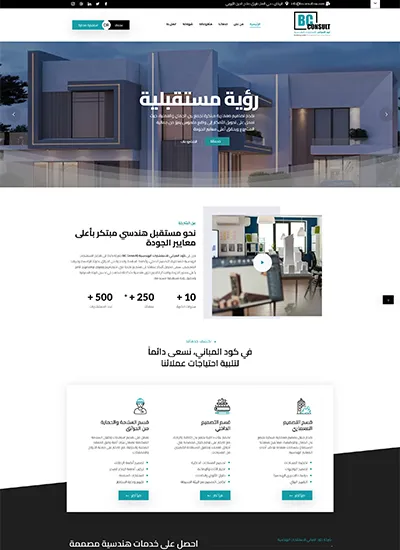
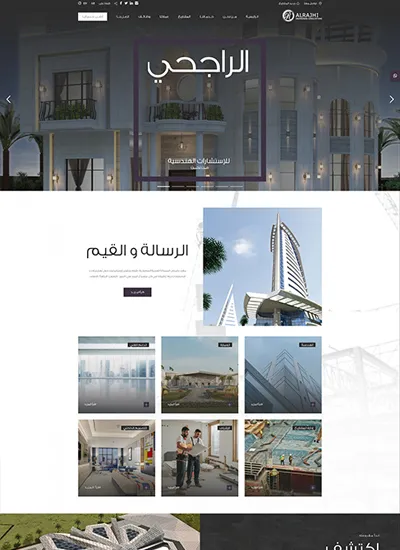
Real projects we delivered

FAQ
What do I post if projects are confidential?
Show the general stages without sensitive details, or publish after handover with the owner’s permission, and rely on knowledge content, the team, equipment and safety.
Do owners and developers care about social media?
Yes. They use it to verify a company’s experience, the scale of its projects and the quality of its work, especially before inviting bids.
Who takes the photos on site?
The site engineer or safety officer can be trained to document with a phone, with professional photo visits at key stages and at handover.

Written from 20+ years designing websites and identities for clients in Saudi Arabia and Egypt — every tip here comes from real projects.
Want this applied to your project?
Book a free consultation — we will review your site or brand and propose a clear plan.
Book a free consultation