- A profile is a sales document: its job is to persuade a specific reader to get in touch or award you the contract.
- The structure: about us, the numbers, services, projects, clients, team, accreditations, contact.
- Projects shown with real photographs and data beat any description.
- Prepare a light digital version (under 10 MB) and a high-quality print version.
- Update it at least once a year.
“Send us your profile.” Every sales manager hears it. What happens next decides a lot: a 60 MB PDF that won’t open on a phone, an old profile with projects from ten years ago, or a tidy, elegant file that leads the reader from trust to getting in touch. A company profile isn’t an introductory brochure; it’s a sales document.
Who reads the profile, and what do they want?
- The procurement manager: can this company deliver my project?
- The tender committee: accreditations, classification, similar projects.
- The partner or investor: size, growth, team, vision.
- The major private client: trust and quality.
The ideal structure, page by page
- Cover: the logo, a strong photograph of a real project, a one-line value statement.
- A message from management (optional): short and sincere.
- About us: the story, the year you were founded, a brief vision and mission.
- The numbers: years of experience, projects, clients, team, cities.
- Services: a page or half a page per service, setting out what it includes.
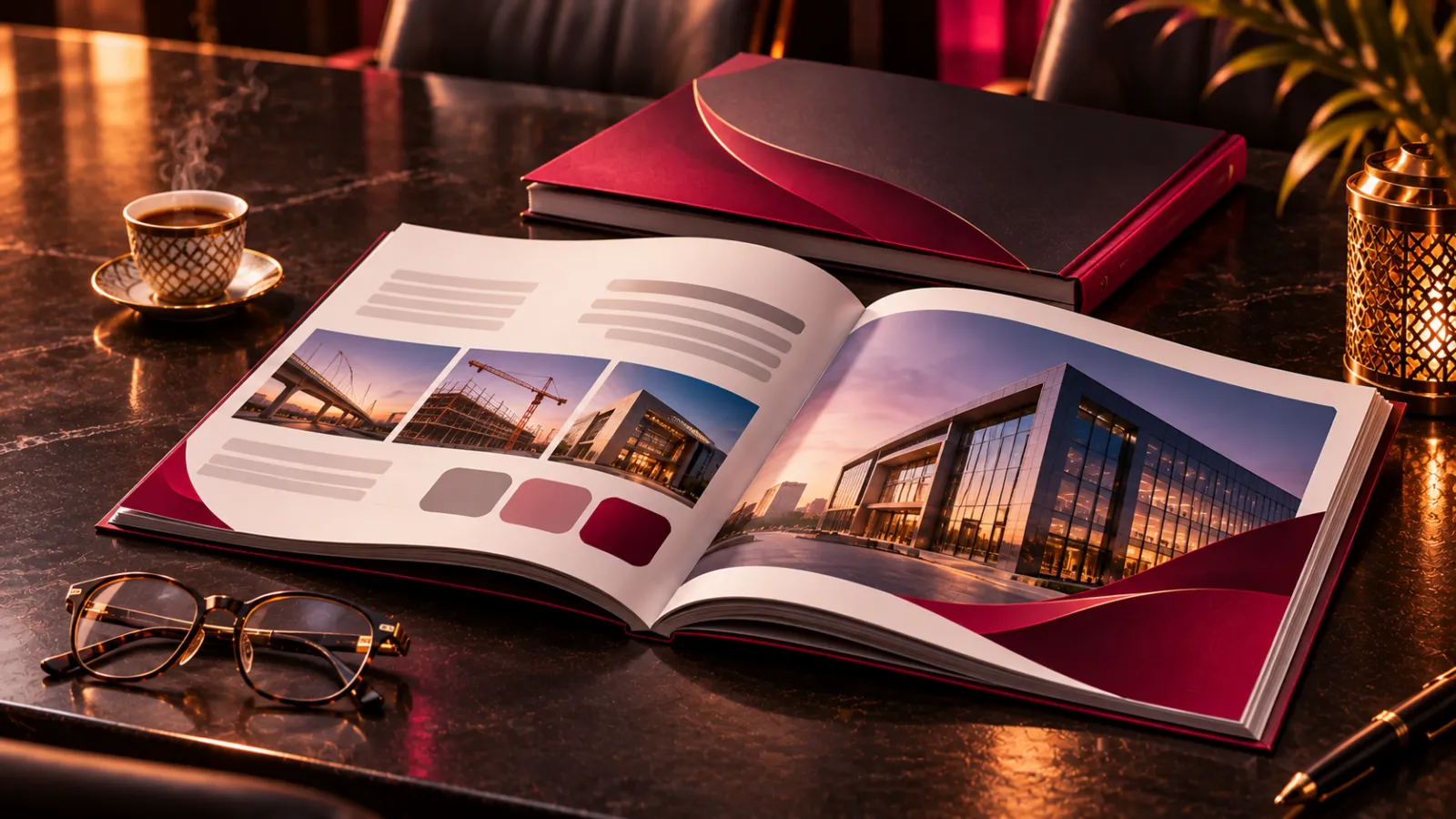
- Projects: a page for each major project (photos, client, location, scope, duration).
- Clients: a wall of logos.
- The team and organisational structure.
- Accreditations: commercial registration, classification, certificates, memberships.
- Quality and safety (for construction and industry).
- Contact: address, phone numbers, email, website, QR code.
Content: the rules of writing
- Facts and figures instead of generic adjectives.
- Short sentences and clear headings; the reader skims rather than reading every word.
- Give every project a small story: the challenge, the solution and the result.
- Language suited to the audience (formal for government bodies, direct for the private sector).
Design
The profile is an extension of the identity: the same colours, typefaces and style. Real, high-quality photographs, white space that rests the eye, and a visual hierarchy that leads to what matters. Read our guide to brand guidelines.
The formats you need
| Version | Specification | Use |
|---|---|---|
| High-resolution CMYK PDF with bleed | Meetings and exhibitions | |
| Digital | Compressed PDF (under 10 MB) with clickable links | Email and WhatsApp |
| Web page | An “About us” page and case studies on the website | Search and quick sharing |
Tip: link the digital profile to your website, so every project in the profile has a page on the site — as with our client pages.
Mistakes that lose you tenders
- A huge file that won’t open on a phone.
- Old projects or stock photos.
- Missing official accreditations.
- Spelling and grammar mistakes in the opening pages.
- No clear contact details at the end.
The digital profile: more than a PDF
Most profiles today are read on screen, and many of them on a phone. So design the profile to work digitally: pages sized for reading on screen, clickable links to the website, case studies and contact details, and a sensible file size that can be sent by email and WhatsApp without trouble. You can prepare two versions: a high-quality print version for exhibitions and meetings, and a light digital version for correspondence. Give the profile a page on your website where it can be downloaded, with a simple form if you want to know who downloads it.
A profile in two languages
In Saudi Arabia, an English profile is frequently requested by large companies, international organisations and consultants. Don’t translate it literally; rewrite it in sound professional English, taking the design direction of each version into account. A single bilingual file can work in some cases, but two separate files are usually clearer and easier to read.
Keeping the profile up to date
An outdated profile is worse than not sending one: old headcounts, projects from five years ago, a logo from before the refresh. Update it regularly, at least once a year, or whenever you hand over a major project or gain a new certification. And design the profile on a template that’s easy to edit, so each update doesn’t need a new design project. Read digital identity and tenders.
Profile and website: a single source of truth
The figures, projects and services in the profile must match the website and LinkedIn. A client who reads “25 years of experience” in the profile and “20 years” on the website starts to have doubts. Best practice is to make the website the up-to-date reference and draw the profile from it at each update.
From our work
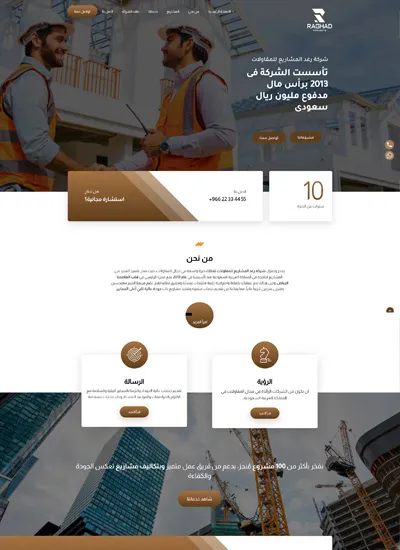
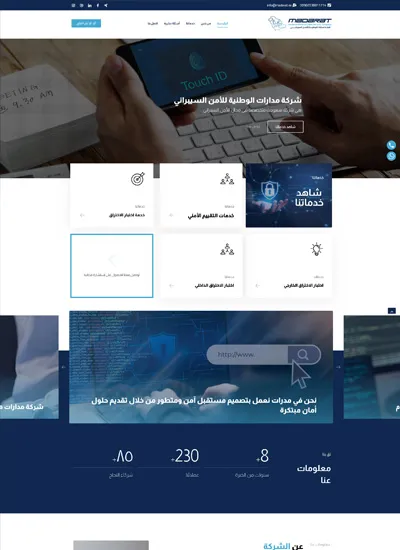
The profile is part of the digital identity projects we deliver, as with Madarat Cybersecurity, and many of our clients in construction and consultancy rely on it to prequalify with government bodies and large companies. We design it in the company’s identity, write its content in language that speaks to the evaluator, and prepare both the digital and print versions.
How do you write the “About us” page?
Avoid generic openings such as “We are a leading company striving to provide the best services.” Start with what matters to the reader: what you do, for whom, for how long, and the proof. For example: “Since 2008 we have delivered residential and commercial projects in Riyadh and the Eastern Province, handing over more than sixty projects to owners, developers and government bodies.” Then add what sets you apart in short points backed by numbers or examples, with a real photograph of the team or your projects. One specific sentence is stronger than a whole paragraph of generalities. Read writing content.
The projects pages
Choose the best eight to twelve projects that represent the range of your experience, and present each with a large, high-quality photograph and brief details: the name, the client (with their permission), the location, the year and the scope of work. Add a short table of further projects at the end for readers who want detail. The photographs are the hero here; a single weak image, or one taken from the internet, shakes confidence in the whole profile.
Profiles for different sectors
No single profile suits everyone. A construction company focuses on projects, plant, safety and classification. A consultancy focuses on its experts, methodology and clients. A technology company focuses on solutions, case studies and figures. A factory focuses on production lines, quality, certifications and capacity. A non-profit focuses on impact, governance and partners. Work out exactly what your reader is looking for, and put it in the first pages, not the last.
When do you need more than one profile?
If your company serves very different sectors (public and private, or consumers and businesses), it may be better to prepare versions aimed at each, sharing the same design and identity but differing in the order of services and the projects shown. A single template makes these versions quick to produce without each one looking as if it came from a different company.
Technical specifications for delivery
Ask the designer to deliver: a high-quality print PDF with bleed, a compressed PDF for digital sending, the open source file for future edits, and separate images of the key pages for posting on social media and LinkedIn. If the profile will be printed, ask for a paper proof before the full run, and choose paper and binding that suit your company’s image; a weighty, elegant printed profile leaves an impression in meetings that a digital file can’t.
A quick checklist before sending the profile
- Dates and figures are current and match the website.
- Every photograph is real and high quality.
- Contact details and links work.
- The file size is suitable for sending.
- No language errors in either version.
The profile at exhibitions and meetings
At an exhibition, a visitor flicks through a printed profile in a minute or two, so make the first two pages say everything: who you are, what you offer and your three strongest pieces of evidence. Add a QR code that leads to the work page on your website or a full digital version. In meetings, leave the profile with the client after the presentation rather than before, so it serves as a reminder of what you discussed.
A good profile opens doors before you knock on them: it reaches decision-makers’ desks ahead of you, presents your experience with confidence, and makes the first meeting shorter and more focused. Start today by reviewing your current profile through the eyes of a client who doesn’t know you.
The bottom line
A good profile answers the reader’s questions before they ask them, and proves your capability with evidence. Update it regularly and keep it consistent with your identity and website. Get in touch to have your company profile designed.
Real projects we delivered
FAQ
How many pages should a company profile be?
Usually between 12 and 30 pages; what matters is that it’s focused. You can prepare a short version for quick sending and a full version for tenders.
Should I put prices in the profile?
Usually not; prices change and belong in quotations. The profile presents capabilities and experience.
Arabic or English?
It depends on your audience; in Saudi Arabia many companies need two versions or a bilingual profile.

Written from 20+ years designing websites and identities for clients in Saudi Arabia and Egypt — every tip here comes from real projects.
Want this applied to your project?
Book a free consultation — we will review your site or brand and propose a clear plan.
Book a free consultation