- In cybersecurity, the identity itself is part of proving technical competence.
- The project covered the logo, visual identity, website, official email, company profile and print as one system.
- Clarity matters more than spectacle: services a non-technical decision-maker can understand.
- Consistency across every touchpoint reflects the discipline clients expect from a protection company.
- Designing the identity with all its applications known in advance saves rework.
When a cybersecurity company gets in touch, we know the task is different from any other sector. This is a company selling something invisible: protection. Its client is an IT director or a risk officer at a Saudi organisation, who reads a lot, checks everything and doesn’t give trust easily. Any untidy detail, from a faded logo to a website without a security certificate, sends the opposite message to the one the company wants to give.
Madarat Cybersecurity is a Saudi company offering penetration testing, vulnerability assessment and security awareness. We built its complete digital identity: the logo, the visual identity, a modern website and communication tools including official email, a company profile and print. In this case study we explain how we approached the project, and the decisions any professional services company can learn from.
The project at a glance
| Item | Details |
|---|---|
| Client | Madarat Cybersecurity — Kingdom of Saudi Arabia |
| Sector | Cybersecurity: penetration testing, vulnerability assessment, security awareness |
| Service | Complete digital identity |
| Deliverables | Logo, visual identity, website, official email, company profile, print |
| Website | madarat.sa |
The challenge: how does a protection company look trustworthy?
The cybersecurity sector in the Kingdom is growing fast alongside digital transformation and the requirements of the National Cybersecurity Authority, and competition includes large global firms and local start-ups. The challenge we set ourselves had three parts:
- Trust: for Madarat to look established and disciplined, not just another new tech company.
- Clarity: for a non-technical decision-maker (a general manager, a procurement manager) to understand what the company offers without complex jargon.
- Modernity: for the identity to reflect the spirit of technology without falling into the usual clichés: padlocks, shields and green numbers on a black background.
Step one: understanding the audience before drawing anything
Before any logo concept, we mapped who would interact with the identity:
| Audience | What matters to them | What the identity must say |
|---|---|---|
| IT director | Technical competence and methodology | Precision, specialism, knowledge of standards |
| Senior management | Reducing risk, protecting reputation | Stability, responsibility, clarity |
| Procurement | Prequalification and documents | Professionalism, consistency, clear information |
| Staff (awareness) | Easy, engaging content | A friendly, understandable visual language |
This simple table governed every later decision. For example, having a security awareness audience meant the identity had to work in a presentation for ordinary employees just as well as in a penetration test report for a technical team.
The logo and visual identity
The name “Madarat” (“orbits”) carries the idea of paths and surrounding circles, close to the concept of multi-layered protection. We built the logo on that meaning rather than on the overused symbols of the sector, with balanced Arabic and Latin lettering that reads clearly at small sizes, because the logo would appear in the browser tab, email signatures and report headers.
Then we expanded the logo into a complete system:
- A colour palette with tones that suggest technology, calm and trust, plus a distinctive accent for alerts and emphasis.
- Approved typefaces for Arabic and English, with set weights for headings and body text.
- Graphic elements derived from the idea of orbits, used in backgrounds and covers.
- Usage rules in brand guidelines to make sure nothing drifts over time. Read the components of brand guidelines.
The website: clarity first
The website is where a prospective client spends the most time with Madarat before getting in touch. So we built it on several principles:
- Services framed around the problem: each service starts with what worries the client and then explains how it’s addressed, rather than a list of terms.
- A modern, clean design that reflects the identity, with white space that rests the eye and highlights the information.
- Performance and security: HTTPS, updates and good speed on mobile; a security company with a slow or insecure website contradicts itself. Read website speed.
- Clear ways to get in touch to request an assessment or consultation.
- Two languages, because part of the audience works in English.
Email, profile and print: the identity beyond the website
In a sector that relies on technical proposals, reports and tenders, the identity appears outside the website more than inside it. So the project extended to:
| Element | Why it matters in cybersecurity |
|---|---|
| Official email and signatures | Any message from unauthenticated email can look like phishing — the last thing a security company wants |
| Company profile | Attached to prequalification and proposals, presenting the services and methodology |
| Document templates | Reports and proposals come out in a consistent identity |
| Business cards, letterhead, and event and awareness materials |
To go further on this point, read domains and business email and company profile design.
Why one project instead of several suppliers?
Had Madarat’s logo been designed by one designer, the website by another company and the profile by a printer, three different versions of the company would probably have appeared. In the integrated project, we designed the logo knowing it would become a website icon, a report stamp and a presentation background, and tested it in all those uses before approval. That’s the core idea of the complete digital identity service, which we explain in detail in what a complete digital identity is.
Lessons your company can use
- Start with the audience: write down who will deal with your identity and what they need to feel.
- Avoid your sector’s clichés: every security company uses a shield, every property company uses a house. Look for meaning in your name or story.
- Test the identity at its smallest: the browser icon and profile picture expose a weak logo quickly.
- Make the website explain, not show off: decision-makers want to understand quickly.
- Don’t forget the everyday tools: email and templates are seen more often than the website itself.
- Document everything in guidelines: so consistency survives as the team grows. Read visual consistency across channels.
How do you measure the success of a digital identity for a professional services company?
Results in professional sectors aren’t measured in likes, but in practical indicators any company can track after launch:
| Indicator | How to track it | What it shows |
|---|---|---|
| Enquiries from the website | Conversion events in Google Analytics | Does the website persuade visitors to take the next step? |
| Enquiry quality | The share of enquiries that fit your services | Do visitors understand exactly what you offer? |
| Sales cycle length | From first contact to contract | Do clients arrive already convinced? |
| Prequalification results | How often you’re accepted as a supplier or invited to tender | Do your documents reflect professionalism? |
| Brand visibility in search | Search Console | Are people searching for your brand by name? |
Review these indicators every quarter and compare them with pre-launch. You’ll usually find the biggest change isn’t in traffic volume, but in the type of clients and how prepared they are at the first meeting. To go deeper on measurement, read our GA4 guide and the cost and return of a digital identity.
Does this approach suit other sectors?
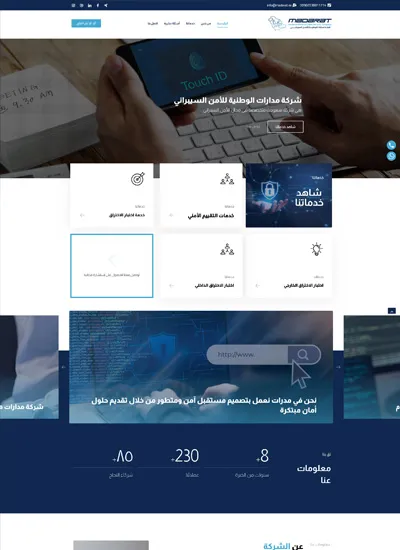
Yes. We’ve applied the same approach with consultancies such as Maad Al Jazeera, technology companies such as Saudi AI, and events companies such as Happiness Makers. What changes is the visual language: calm and precision in security, energy in events, gravitas in consultancy. The method — understanding the audience, an identity system, a clear website, unified communication tools — stays the same. See the full project page and its images on the Madarat page; the same approach is available to your company.
The bottom line
The Madarat project sums up our philosophy: an identity isn’t a pretty logo but a complete system that makes a company look as it really is — professional, disciplined and trustworthy — at every point the client sees it. If your company is at a similar stage, see our work or get in touch and we’ll start by understanding your audience.
Real projects we delivered
FAQ
What did the Madarat project include?
A complete digital identity: logo design, the full visual identity, a modern website, official email, the company profile and print.
Why does a cybersecurity company need a strong identity?
Because clients buy trust before they buy the service. A well-ordered identity and a secure, fast website are practical proof of professionalism.
Can the same approach be applied to my company?
Yes. The same approach (understanding the sector, an identity system, a website, communication tools) suits any professional services company, with the visual language varying by sector.
Sources

Written from 20+ years designing websites and identities for clients in Saudi Arabia and Egypt — every tip here comes from real projects.
Want this applied to your project?
Book a free consultation — we will review your site or brand and propose a clear plan.
Book a free consultation