
- Digital transformation starts with the customer experience: how they find you, contact you and buy from you digitally.
- A professional digital presence (identity, website, accounts) has become a condition for competing and for tenders.
- The second step is digitising operations: quotations, invoices, follow-up, archiving.
- Data and measurement turn instinct into decisions.
- Start with a small, measurable phase rather than one huge project.
In recent years the Kingdom has moved remarkably quickly towards digital services: from government transactions to payments, e-invoicing and platforms that have become part of every company’s day. This shift has raised customers’ expectations too; a customer who completes a government transaction on their phone in minutes expects the same experience from your company. The question is no longer “Should we go digital?” but “Where do we start, and in what order?”
What does digital transformation mean for a small or medium-sized company?
It doesn’t mean buying complex systems; it means rethinking three core journeys so they run smoothly online:
- The customer journey: how they find you, evaluate you, contact you, buy and follow up.
- The internal work journey: how quotations and invoices are produced, projects followed up and documents stored.
- The data journey: how you know what’s working and what isn’t, and make decisions by the numbers.
Phase one: a professional digital presence
This is the starting point for most companies, because it directly affects sales, trust and tenders.
- A clear visual identity applied to everything. Read why visual identity matters.
- A professional bilingual website that’s fast on mobile, with real service and project pages.
- Official email in the company’s name instead of free email. Read our guide to domains and business email.
- A Google Business Profile and well-organised social accounts.
- A digital company profile ready to send for tenders and to major clients.
Together, these components are what we call a complete digital identity, and delivering them through one team ensures they all speak the same language.
Phase two: digitising everyday operations
| Process | Before | After |
|---|---|---|
| Quotations | Scattered Word files | Standard templates and a system for issuing and tracking |
| Invoices | Manual | E-invoicing compliant with the requirements |
| Customer follow-up | An employee’s memory and personal WhatsApp | A simple CRM or an organised WhatsApp Business |
| Documents | Paper and folders | Electronic archiving with permissions |
| Meetings | Paper minutes | Committee and meeting management systems |
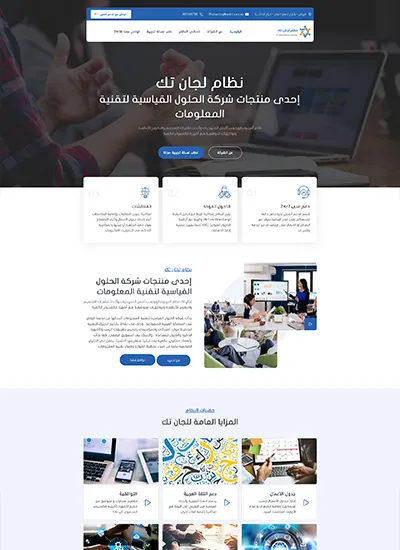
Some of our clients have built their entire product around this need: Lijan Tech for managing committees and decisions, and EasyDocs for electronic archiving.
Phase three: data and decisions
- Measure website traffic and customer sources. Read our GA4 guide.
- Dashboards for sales and projects.
- Collect customer feedback regularly.
- Make gradual use of AI tools in content, customer service and analysis.
A realistic six-month plan
| Month | Deliverables |
|---|---|
| 1 | Audit the current digital presence, set priorities |
| 2–3 | Identity, website, official email and Google Business Profile |
| 4 | Digitise quotations and invoices, set up WhatsApp Business |
| 5 | Measurement and reporting, regular content |
| 6 | Review results and plan the next phase |
Common mistakes
- Buying a big system before the processes are clear.
- A beautiful website with no content, maintenance or measurement.
- Commissioning every element from a different supplier with no unified identity.
- Neglecting to train the team on the new tools.
- Ignoring data protection and security. Read our WordPress security guide.
Digital transformation isn’t buying software
Many companies understand digital transformation as buying a system or an app, then find that the team doesn’t use it, or that it doesn’t integrate with the rest of the work. Real transformation starts with a question: which processes consume time and effort and cause errors today? Then choose the simplest tool that solves them, train the team on it and measure the effect. A simple system everyone uses beats an advanced one everyone ignores. And cultural change inside the company — the team’s willingness to change the way it works — matters more than the technology itself.
The essential digital infrastructure for any Saudi company in 2026
| Element | Why |
|---|---|
| A professional bilingual website | The front that customers, authorities and partners check |
| Verified official email | Professionalism and reliable delivery |
| Google Business Profile and organised social accounts | Local visibility and everyday communication |
| Compliant e-invoicing | Zakat and tax requirements |
| Cloud accounting and inventory | Accurate, real-time data |
| A customer relationship management tool | Following up opportunities so no customer gets lost |
| Cloud storage and backups | Data protection and business continuity |
| Basic cybersecurity | Two-factor authentication, updates, staff awareness |
Government support and initiatives
Bodies such as the Small and Medium Enterprises General Authority (Monsha’at) offer programmes and initiatives to support the digitisation of businesses, and these programmes and their conditions change from time to time. Check the official platforms to see what suits your business before planning your digital investments; you may find support that offsets part of the cost.
From our work
We work with Saudi companies at different stages of their digital journey: from building the core presence (identity, website, email), as with Maad Al Jazeera, to digital systems for managing operations such as Lijan Tech and EasyDocs. Explore our complete digital identity service.
Digital transformation and competing for projects
As major projects expand in the Kingdom, project owners and developers expect a higher digital standard from suppliers and contractors: electronic reports, organised correspondence, digital prequalification platforms and sometimes shared project management systems. A company that has been slow to digitise its operations may find itself out of the running for bigger projects — not because its expertise is weak, but because it isn’t ready to work the way the client expects. Read digital identity and tenders.
Cybersecurity is part of the transformation
Every digital step adds value and adds risk at the same time: more data in the cloud, more accounts, more suppliers. So digital transformation must be accompanied by a minimum level of security: two-factor authentication on every account, regular updates, backups, staff awareness of phishing, and permissions limited by role. The National Cybersecurity Authority publishes controls and awareness material that is useful for businesses. Read backups and responding to a hack.
Measuring the transformation
Set indicators before you start: the time taken to complete core processes, the error rate, the number of digital orders, customer satisfaction and operating cost. Then compare after six months. A transformation that isn’t measured is hard to justify continuing; one whose effect shows in the numbers wins the support of management and the team.
The practical summary
Start with a professional digital presence, then digitise the most time-consuming processes, then use data in your decisions, with security protection at every stage. Remember that transformation is a gradual journey, and a simple tool everyone uses is better than a complex system nobody uses.
Where should you start today?
List the tasks your team repeats by hand every day, and estimate how much time they take each week. Choose the most time-consuming task that’s easiest to digitise, and find a simple solution for it. In parallel, make sure your core digital presence (website, official email, Google profile) is professional, because it’s the face the market sees before any dealings. Companies that start today with small, regular steps move faster than those waiting for a perfect plan that never arrives.
Our clients’ experience in the Kingdom
Construction companies that moved from paper profiles to websites with project databases and digital prequalification files have found prequalification with authorities easier. Engineering offices that became regular on LinkedIn became known to consultants and developers before the first meeting. Charities that enabled online giving widened their base of supporters. These examples show that digital transformation starts with small, practical steps that have a direct effect, not with huge projects. Read the complete digital identity.
Take one clear step today, measure its effect, then move confidently to the next. Vision 2030 is a real opportunity for companies that are digitally ready.
The bottom line
Digital transformation is a journey in phases: it starts with a professional digital presence that attracts customers and builds trust, then digitising operations, then data-driven decisions. Start small, measure and expand. Book a free consultation and we’ll assess your digital position and suggest the first step.
Real projects we delivered
FAQ
Is digital transformation expensive for small companies?
You can start with low-cost, high-impact steps: a professional website, official email, a Google Business Profile, and cloud tools for invoicing and follow-up, then expand gradually.
Where do I start?
With your biggest pain point: if customers can’t find you, start with your digital presence; if operations are slow, start by digitising them.
Do I need a custom-built system?
Usually not at first; off-the-shelf tools are often enough, and custom systems come when you have clearly unique processes.
Sources

Written from 20+ years designing websites and identities for clients in Saudi Arabia and Egypt — every tip here comes from real projects.
Want this applied to your project?
Book a free consultation — we will review your site or brand and propose a clear plan.
Book a free consultation