
- Write about the client’s problem and result, not just about yourself.
- The main headline answers: what do you offer, for whom, and why you?
- Replace generic adjectives (“the best”, “outstanding”) with facts, figures and examples.
- Every service page answers the client’s questions in the order they ask them.
- Writing for SEO means clearly answering what people search for, not stuffing keywords.
We often hear: “The design is ready; we’ll write the copy later.” Then it’s written in a hurry: “We are a leading, distinguished company offering the best services at the highest quality.” That sentence fits any company in the world, which is why it convinces no one. Content is what clients read to decide and what Google reads to rank. Here’s our method.
Before you write: know your reader
- Who are they? A small business owner? A procurement manager? A donor?
- What’s their problem? Why are they searching now?
- What are their fears? Price, delays, quality, working remotely?
- What do they search for on Google? Read the keyword research guide.
- What makes them trust? Work, figures, well-known clients.
The home page: a practical template
- Headline: the result the client gets. Example: “Websites and identities that win clients for contracting companies in Saudi Arabia.”
- Supporting line: how, for whom, and since when.
- Main button: a clear action — “Book a free consultation”.
- Proof: figures and client logos.
- Services: a heading and a sentence for each service, leading to its page.
- Why us: 3–4 reasons with facts.
- Selected work.
- A final call to get in touch.
The service page: questions in order
| The client’s question | The section on the page |
|---|---|
| Is this service for me? | A headline and introduction describing the problem and audience |
| What exactly will I get? | The list of deliverables |
| How do you work? | The steps and duration |
| Are you really good? | Examples, clients and results |
| What does it cost? | Ranges or pricing factors |
| What about my concerns? | Frequently asked questions |
| How do I start? | A clear contact button |
That’s how the website design and online store pages on our site are built.
The about page: a story, not a CV
Start with why the company began, then what you’ve learned, then who you serve today, then the team and values with examples. The reader wants to know: “Are these people I can trust?”.
Wording rules we always apply
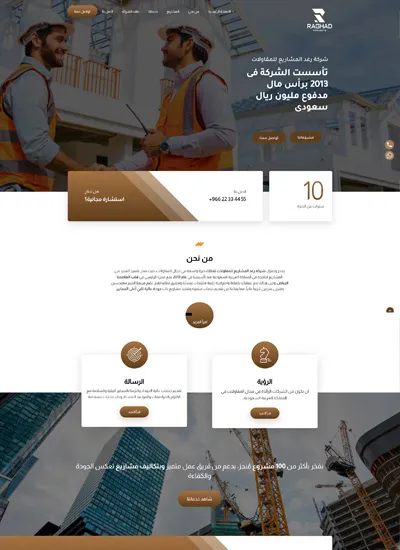
- Facts instead of adjectives: “we’ve delivered 100+ projects for 50 clients” is stronger than “extensive experience” — as in the story of Raghad Projects.
- More “you” than “we”.
- Short sentences and paragraphs of 2–4 lines.
- Subheadings that summarise, because most visitors scan the page.
- Verbs on buttons: “Request a quote”, “See the live site”.
- Your audience’s language: plain language and their sector’s terms.
- No keyword stuffing: use keywords naturally in the headline, introduction and subheadings.
Before and after
| Before | After |
|---|---|
| We are a leading company in providing event management services at the highest quality. | We run conferences and exhibitions in Riyadh from design to the last guest — more than 200 events for government and private organisations. |
| Contact us for more information. | Send us the details of your event and we’ll reply with an initial proposal within 24 hours. |
(The figures in the example are illustrative; always use your real figures.)
Content and answer engines
AI answer engines quote clear, direct sentences. Write short definitions, explicit answers in the first line of a paragraph, and real frequently asked questions. Read SEO, AEO and GEO.
Headlines: the sentence that decides whether a visitor continues
Most visitors read only the headlines, then decide whether the rest is worth reading. A good headline on a company website says clearly what you offer, for whom and with what benefit — without exaggeration or vagueness. Compare “Integrated solutions for a changing world” with “Website and identity design for contracting companies in Saudi Arabia since 2005”. The first could belong to any company in any field; the second tells visitors within two seconds whether they’re in the right place. Under the headline, a supporting line shows the proof or advantage, then one clear button for the next step.
For subheadings within pages, use the questions clients actually ask, such as “How long does the project take?” and “What happens after delivery?”. This makes the page easy to scan, and helps search engines and answer engines match your page with users’ questions.
Tone: how does your company speak?
Every brand has a voice. A legal consultancy speaks with gravity and precision, a youth clothing store with energy and lightness, and a contracting company with practical confidence. Define your tone in three adjectives (for example: clear, confident, friendly), then write all content in it: the website, social media, email and system messages. Choose a form of address and stick to it. In the Saudi market in particular, clear, simplified standard Arabic is the safest choice for professional websites, with a touch of dialect possible on social media depending on the brand.
Figures and proof: from claim to evidence
“We provide an outstanding service” is a claim. “We delivered 47 residential projects in Riyadh over five years” is evidence. Every claim on your site should be backed by a documented figure, a client’s name with permission, a real photo or a certificate. Avoid exaggerated or unverifiable figures; professional audiences distrust huge round numbers more than they trust them. Honesty with small numbers is stronger than exaggeration with big ones.
The call to action
Every page should end with a clear next step: “Request a quote”, “Book a free consultation”, “Talk to us on WhatsApp”, “See our work in your sector”. Vague buttons such as “Submit” or “Click here” are far weaker than buttons that describe the outcome. Place the button in several spots on long pages, not just at the end. Read landing pages and conversion.
Reviewing before publishing
- Read the text aloud; long, stumbling sentences will show immediately.
- Delete every word that adds no meaning (“in addition to that”, “it is worth mentioning”).
- Make sure every paragraph carries one idea.
- Check spelling and grammar; language mistakes shake trust.
- Read the text on a phone screen, because a paragraph that looks fine on desktop becomes a wall of words on a phone.
Content for mobile first
Most of your visitors read on their phones, where a five-line paragraph on desktop looks like ten lines. Write short paragraphs of two or three lines, use lists and subheadings generously, and put the most important information at the start of the paragraph, not the end. Avoid wide tables on core pages, or make them scroll within themselves. Test every page on your phone before approving its copy.
Bilingual content: localisation, not translation
If your site is in Arabic and English, don’t translate the text literally. An attractive Arabic headline may become clumsy in English, and vice versa. Write each version for its audience: the same message and information, phrased naturally in each language. Professional terminology needs a specialist’s review in each language. Ideally the English version is written or reviewed by someone who writes it fluently, not a machine translation tool. Read bilingual websites.
Test your copy
If you have enough traffic, try two versions of the home page headline or a button’s text for a period and compare the contact rate. Sometimes changing one sentence lifts results more than a complete redesign. Read conversion rate optimisation.
How long should a page be?
There’s no single ideal length. The home page needs to be clear and focused; a service page needs enough detail to answer all a serious client’s questions, and may exceed a thousand words if the service is complex. The rule: every sentence must earn its place. Long, boring content drives visitors away; very short content leaves them with unanswered questions. Organise long content with headings and lists so every reader finds what matters to them quickly.
The bottom line
Good content respects the reader’s time: it understands their problem, offers proof and tells them the next step. In our projects we write the content in parallel with the design, after an interview session with you. Book your session or see our work.
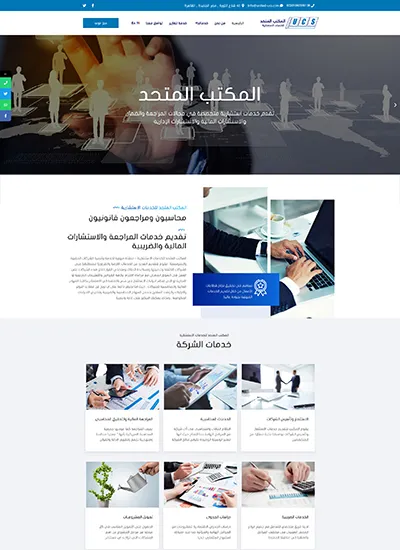
Real projects we delivered

FAQ
Who should write the website content?
You know your business better than anyone, and a professional writer knows how to phrase it for clients and search engines. The best result comes from an interview session followed by a writer, then your review.
Should the content be long?
It should be enough to answer. A good service page is usually between 500 and 1,200 words divided by headings; the home page is shorter and leads to the detailed pages.
Should I use AI to write content?
It’s useful for drafts and ideas, but the content must carry your expertise, real examples and human review — Google rewards helpful, original content.
Sources

Written from 20+ years designing websites and identities for clients in Saudi Arabia and Egypt — every tip here comes from real projects.
Want this applied to your project?
Book a free consultation — we will review your site or brand and propose a clear plan.
Book a free consultation