
- Customers judge your company’s size and seriousness from its digital presence before any meeting.
- Visual inconsistency across channels weakens recognition and trust.
- Free email and a slow website cost you deals without you knowing.
- A complete digital identity fixes every sign at once, in one language.
- Start with a quick audit of your current presence using the list in this article.
Every week we meet owners of companies that are successful in the real world: excellent projects, satisfied clients, a good reputation. But when we open their digital presence, we find a picture completely different from the reality. The problem is that a new customer doesn’t know the reality; they only see the screen. Here are the signs we see most often — and each one costs you customers.
Your logo changes from place to place
One version on the business card, another on the website, and a third stretched out of shape on Instagram. When a logo has no official versions and no usage guide, everyone “reinvents” it. The result: customers don’t remember you, because the mind remembers what repeats in the same form.
The fix: official logo versions (horizontal, vertical, icon, single colour) and a short guide. Read the components of brand guidelines.
Your website doesn’t work well on mobile
Most visits come from phones. If the text is small, the buttons are crammed together and the contact button is hidden, you lose most of your visitors in seconds.
The fix: a website designed mobile-first. Read responsive design.
You email customers from a free address
A high-value quotation arriving from a personal Gmail account raises a silent question: is this a real company? Official email on your domain is one of the simplest and cheapest signs of professionalism.
The fix: official email with a consistent signature. Read our domain and business email guide.
Your social accounts are neglected or haphazard
The last post was a year ago, or every post uses different colours and typefaces. Many customers check your accounts before getting in touch, and a neglected account suggests a company that has stalled.
You don’t have an up-to-date profile you can send in a minute
When a procurement manager asks for a company profile and you need days to prepare one — or you send a file from five years ago — you lose points before the evaluation even starts. Read company profile design.
You don’t appear on Google when customers search for your service
If a customer types your service and city and doesn’t find you, they’ll probably find your competitor. A digital presence without SEO is like a beautiful shop on a street nobody walks down. Read our SEO guide.
Every element was produced by a different supplier
A designer for the logo, a company for the website, a printer for the profile, an employee for social media. Each did their best, but nobody is responsible for the whole picture.
A quick test: how many signs do you have?
| Number of signs | Assessment | Suggested action |
|---|---|---|
| 0–1 | A good presence | Maintenance and continuous improvement |
| 2–3 | An uneven presence | Unify the identity and update the key assets |
| 4 or more | Your presence is hurting the company | A complete digital identity |
Why an integrated fix rather than patching?
Fixing each sign separately with different suppliers recreates the same problem: fragmentation. A complete digital identity builds the whole system at once — the identity, then the website, then email, then the profile, then social templates — in one language and with one party responsible. Read why one package.
Your website doesn’t show your real work
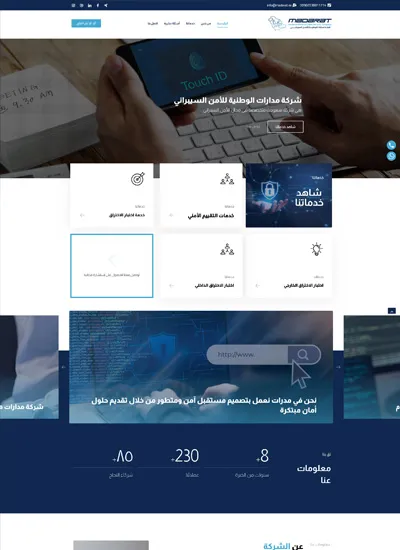
Many company websites talk about “quality”, “professionalism” and “experience” without showing a single real project with photos and details. Today’s customers want evidence, not description: What have you delivered? For whom? What was the result? If your website has no real work, or shows stock images from free photo sites, you’re asking customers to trust you without giving them a reason. A well-organised work page with real photos and short case studies is one of the most persuasive tools you can have. Read the Madarat case study.
You don’t know where your customers come from
If I asked you now: how many customers came to you from the website last month? From LinkedIn? From Google search? Would you know the answer? A lack of measurement is a sign that your digital presence is working as a silent shop front rather than a growth tool. A complete digital identity includes measurement from day one: website analytics, conversion events and tracked links, so you know which channel deserves more investment. Read our GA4 guide.
It takes you days to send a professional proposal
When a customer asks for a quotation, does your team have a ready template in the company’s identity, up-to-date photos and approved text about the company and its services? Or do they start from scratch every time in a Word file with the default font? Companies with ready templates send faster, more professional proposals, and gain a clear advantage in tenders where timing decides. Read digital identity and tenders.
What happens when you fix the signs?
Companies that rebuilt their digital presence as one system usually notice practical changes: customers arrive at the first meeting having read about the company and understood its services, quotations go out faster and look stronger, prequalification with authorities and large companies becomes easier, the team is proud to send the website link and profile, and recruitment attracts better talent. These results don’t come from one element, but from every element being consistent together.
Where do you start?
If you’ve found three or more signs, start with a simple inventory: list every digital touchpoint of your company (website, email, accounts, profile, Google listing, templates), rate each from 1 to 5, and order them by how much they matter to your customers. You’ll usually find the problem isn’t a single element, but the absence of a system that ties them together. That’s where an integrated approach pays off, rather than fixing each element separately with a different supplier. Read what a complete digital identity is and its cost and return.
From our work
Many of our clients came to us with several signs from this list: a logo in more than one version, an old website that doesn’t work on mobile, free email and neglected accounts. In projects such as Madarat, Happiness Makers and Saudi AI, we built the identity, website and digital tools as one consistent system, and these signs disappeared in one go. Every sign on this list can be fixed, and it’s best to fix them together as one system.
Frequently asked questions
Do I need to fix all the signs at once? It’s best to treat them as one system, but they can be phased, starting with whatever affects your customers most.
How long does the fix take? A complete digital identity project for a medium-sized company usually takes six to ten weeks.
The ten-minute test
Open your website on your phone now, then search for your company name on Google, then open your LinkedIn and Instagram accounts, then look at your email signature and the last quotation you sent. Do they all look like they come from one professional company? If you hesitate to answer, that’s the most important sign of all.
The practical summary
If you’ve found three or more signs, your digital presence is subtracting from your customers’ trust rather than adding to it. The fix doesn’t take a year; a single integrated project can turn all these signs into strengths within weeks. Start with the quick test, then get in touch and we’ll review your presence together.
A final word on timing
Every month with a weak digital presence means opportunities going to competitors who look more professional, even if your service is better. The good news is that the fix is faster than you’d expect when it’s done as one system — and every sign you fix today saves you customers you would have lost tomorrow.
The bottom line
Your digital presence is your first salesperson. If you’ve found two or more signs from this list, it’s the right time to rebuild it as one system. Explore the complete digital identity or book a free audit.
Real projects we delivered


FAQ
What’s the difference between a visual identity and a complete digital identity?
The visual identity is the visual system (logo, colours, typefaces); a complete digital identity applies that system to all your digital assets together: the website, email, company profile, social accounts and Google listing.
Do I need to change my logo if it’s acceptable?
Not necessarily; sometimes it’s enough to refresh it and build a consistent system around it, and sometimes the logo itself is the problem.
How long does a complete digital identity take?
Usually 6 to 10 weeks, depending on the size of the website and the number of applications required.

Written from 20+ years designing websites and identities for clients in Saudi Arabia and Egypt — every tip here comes from real projects.
Want this applied to your project?
Book a free consultation — we will review your site or brand and propose a clear plan.
Book a free consultation